Multi-objective pathway selection for sustainable biorefinery process (IF=10.9. JCR 1.9%)
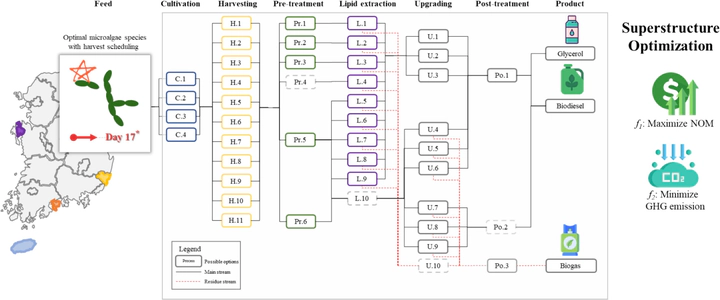
Prof. SungKu Heo published a research paper on optimal microalgae-based biorefinery design under time-varying climatic conditions. This study proposes an integrated framework that combines kinetic growth modeling, harvest scheduling optimization, and multi-objective superstructure optimization to enhance both economic and environmental performance of microalgae biorefineries. By incorporating temperature and solar radiation data, the research identifies optimal harvest intervals using a genetic algorithm and determines the best process pathways balancing profitability and carbon emissions. The results demonstrate that Asterionella formosa achieves the highest biomass productivity, while the optimized system improves net operational margin and significantly reduces CO₂ emissions. The findings highlight the potential of climate-adaptive, optimization-driven strategies for sustainable large-scale biofuel production. The paper is accessible via the following DOI link: https://doi.org/10.1016/j.enconman.2025.120247.
Greenest A.I. Lab
Led by Prof. SungKu Heo
We work for digital and autonomous solutions for a climate-resilient future, and push boundaries across autonomous systems, decarbonization, and circular innovation.